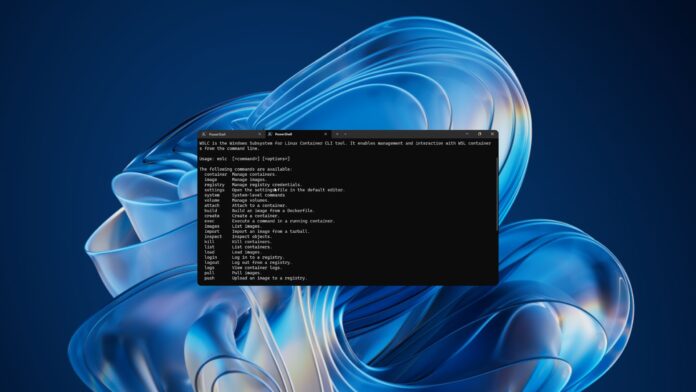
Beyond fixing its operating system, MS spent 2026 making Windows more attractive to developers. WSL became faster, Linux containers are now built into Windows 11, MS released Linux-like Coreutils, and the more recent Windows Developer Configurations can turn a new PC into a ready-to-code machine with a single command.
However, a new developer poll spotted by Windows Latest appears to undermine those efforts. Gergely Orosz, who runs The Pragmatic Engineer, asked his audience on X which operating system they use to build software and received roughly 4,000 responses:
- macOS: 61.6%
- Linux: 24.2%
- Windows: 12.8%
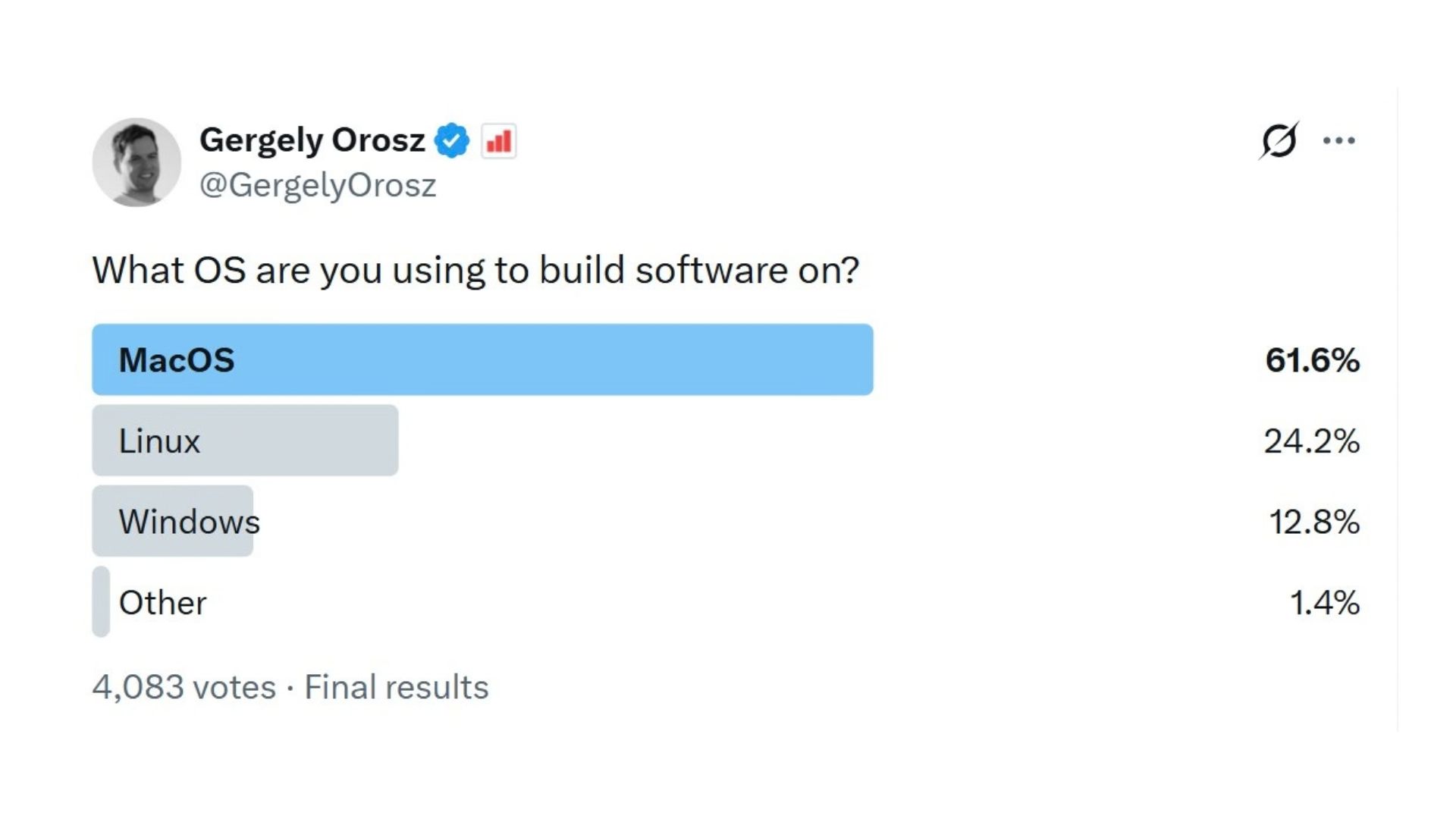
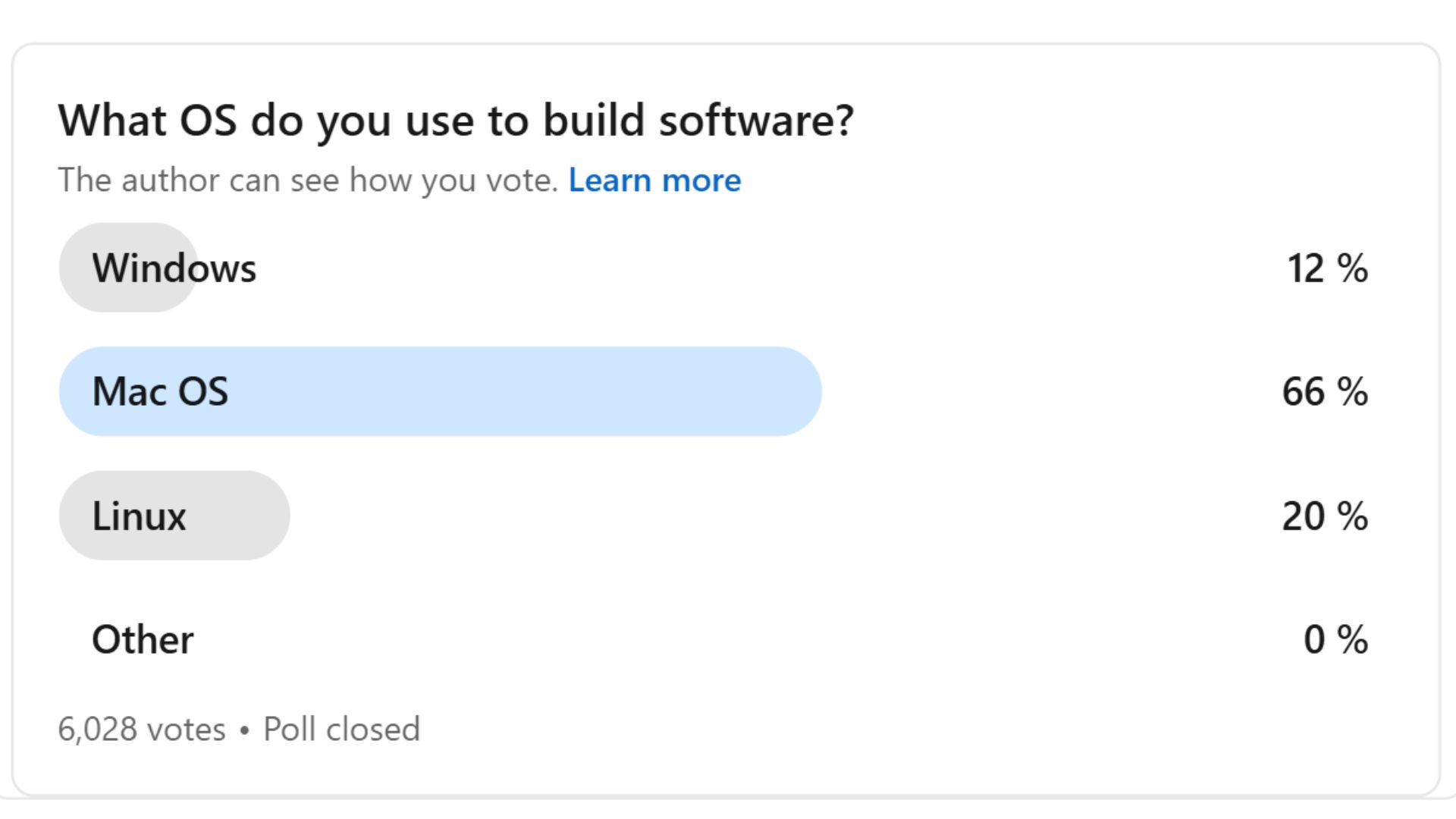
Windows came in a distant third. Another LinkedIn poll conducted as research for the same newsletter received 6,000 votes, with macOS, Linux, and Windows receiving 66%, 20%, and 12%, respectively—results similar to those from X.
Of course, this was not a survey of every developer worldwide. Orosz described the audience as his “bubble,” consisting largely of developers at startups and Big Tech companies. The findings do not overturn the much larger surveys showing that Windows remains widely used.
Still, this presents an uncomfortable situation for MS. Redmond is doing a great deal to make Windows developer-friendly, yet developers continue to choose Macs and Linux machines.
The 12% Figure for Windows Reflects Preference More Than Market Share
The 2025 Stack Overflow Developer Survey, which included tens of thousands of respondents worldwide, provides a broader perspective. It found Windows to be the most widely used primary operating system among professional developers, at roughly 49.5%, compared with 32.9% for macOS.
Because it was a multiple-selection survey, it is fundamentally different from Orosz’s single-choice poll. The 12.8% and 49.5% figures cannot be placed side by side as evidence that one is incorrect.
Either way, the gap between the two surveys suggests that Windows is particularly weak among the highly visible startup and Big Tech community, even though it remains widely used across the global developer population.
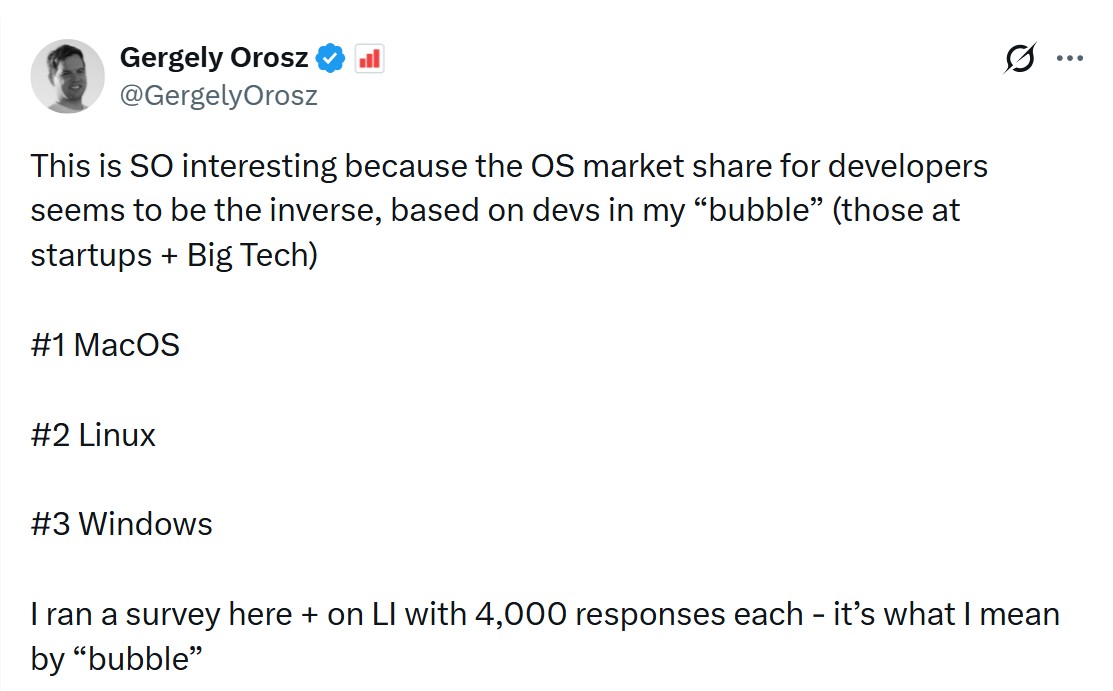
A screenshot posted by the creator of Omarchy, which prompted Orosz to explain his poll, shows Statcounter’s U.S. desktop chart with Linux near 18% and Windows above 50%.
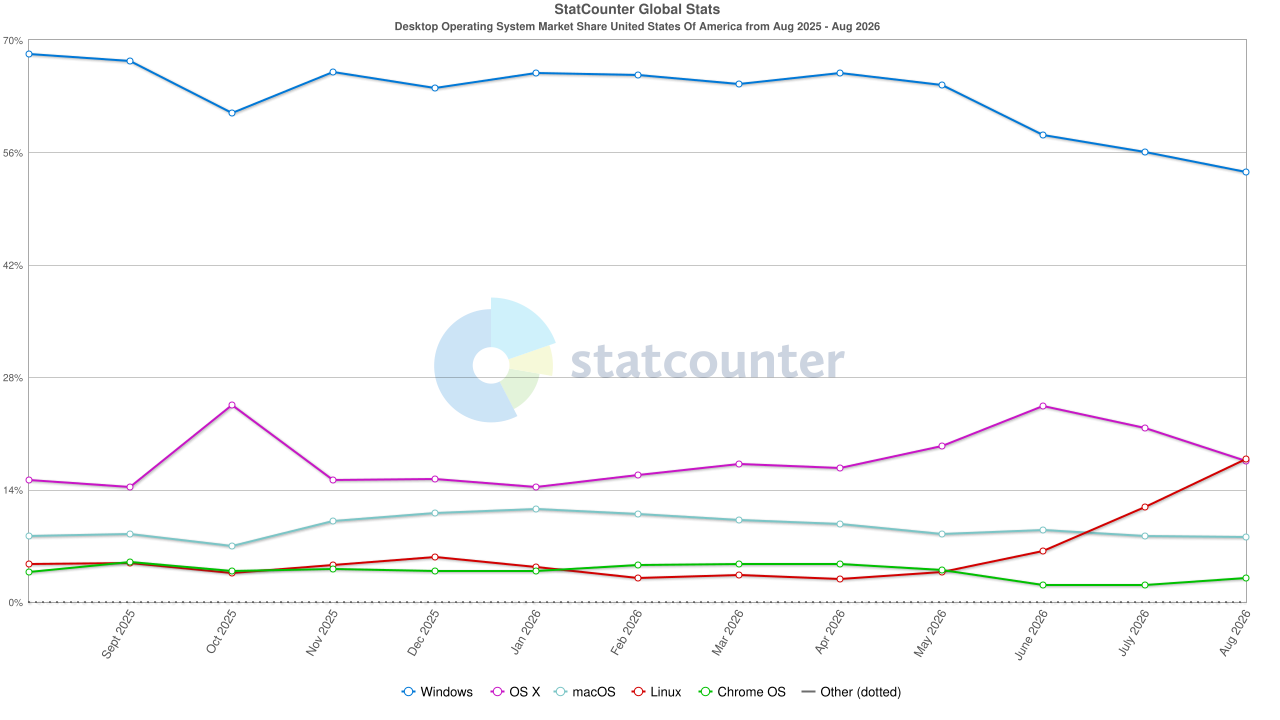
However, Statcounter measures page views rather than people or developer machines, although its methodology states that it attempts to remove bot activity from a sample consisting of billions of monthly page views.
Statcounter also continues to list OS X and macOS as separate operating systems, years after Apple renamed OS X to macOS. Windows Latest previously flagged this type of misinterpretation when a viral screenshot claimed that Windows had fallen from 79% to 56% in two months. The apparent decline resulted from a classification error that Statcounter later corrected, not a mass departure from Windows.
We also examined a viral report about a spike in Linux usage by comparing it with Cloudflare’s human-versus-automated traffic data. Linux accounted for around 4.7% of human-only traffic in North America, while automated traffic pushed its share as high as 26% on individual days.
Why Do Developers Keep Choosing macOS and Linux?
One word: Unix.
MacBooks have their appeal, but more importantly, macOS gives developers a Unix-based environment with familiar command-line tools and package managers, all within a desktop experience that generally stays out of the way and avoids bloatware and upselling. It also helps that Apple’s M-series chips are best in class for performance and battery life.
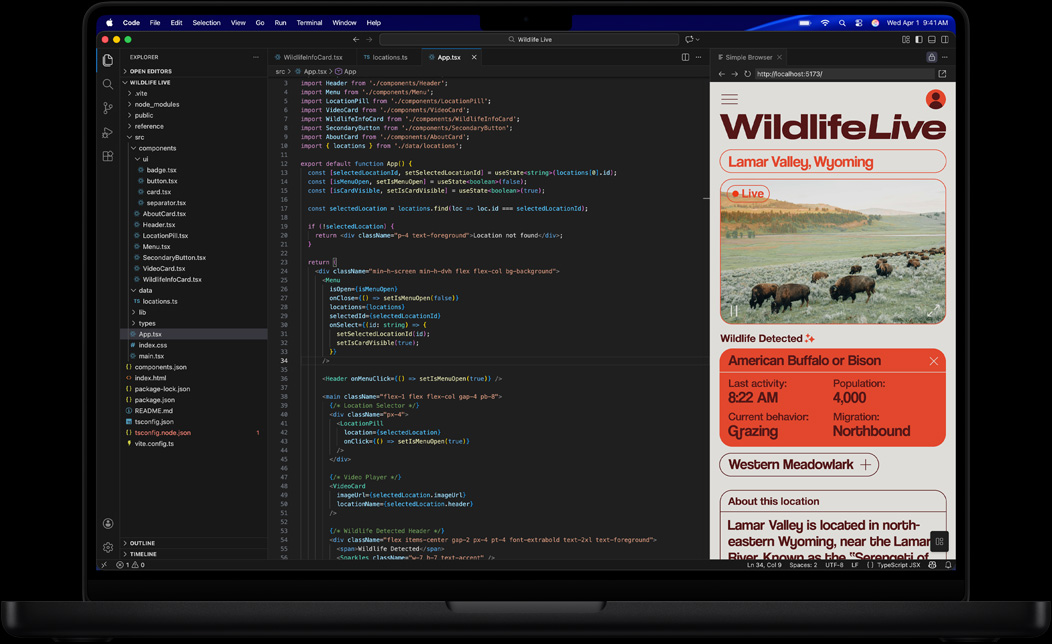
There is also Xcode, which has always required macOS and provides the only SDKs and simulators for iOS, iPadOS, watchOS, and visionOS. For anyone building software for Apple platforms, choosing a Mac is the only option. If posts on X are any indication, Apple users are also more likely to pay for applications, potentially generating more revenue for developers.
Developers working with servers, containers, cloud infrastructure, and many AI workloads often want their development environment to resemble the Linux environments where their software will ultimately run. This helps explain why Linux is preferred for work involving Docker, Kubernetes, Python, and cloud infrastructure.
MS’s WSL support documentation highlights Linux environments, containers, and GPU acceleration. It also warns that storing project files on the Windows file system while running Linux build tools through WSL introduces I/O overhead.
Windows still offers significant advantages. Visual Studio remains one of the dominant development environments, .NET officially supports Windows, Linux, and macOS, and Windows maintains a substantial enterprise footprint alongside clear dominance in PC gaming.
WSL gives developers access to Linux without requiring them to abandon Windows entirely, and MS has invested heavily in Dev Drive, Windows Terminal, WinGet, and other developer tools.
The problem is that many developers do not choose Windows because they need Windows. They want a Unix-like environment, and MS has increasingly responded by placing Linux inside Windows.
MS Is Effectively Rebuilding Windows Around Developers and AI
Steve Ballmer once shouted “developers, developers, developers” across a stage. It worked at the time, but two decades later, MS is still pursuing developers, even though the challenge could not be more different.
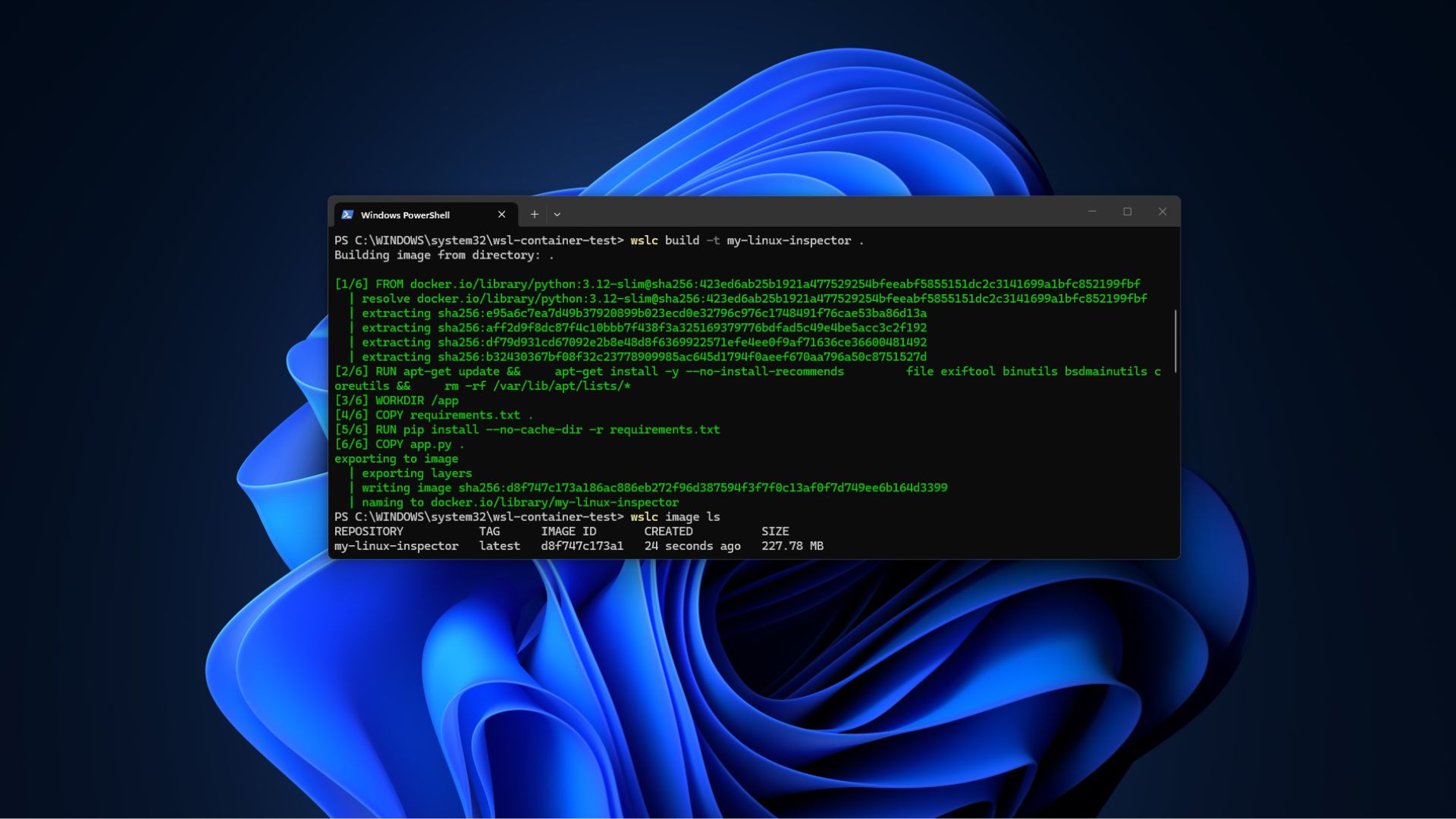
MS spent 2026 upgrading WSL with faster file access, improved networking, and easier setup. The company describes WSL as foundational to running Linux workloads on Windows. This work led to WSL Containers, a built-in wslc tool for building and running Linux containers without third-party software such as Docker Desktop.
Interestingly, Canonical Vice President of Engineering Jon Seager told The Pragmatic Engineer that Ubuntu usage within WSL is growing faster than native Ubuntu desktop installations. He expects WSL usage to overtake native Ubuntu within months, driven largely by developers who receive Windows laptops from their employers but need Linux for AI and machine-learning work.
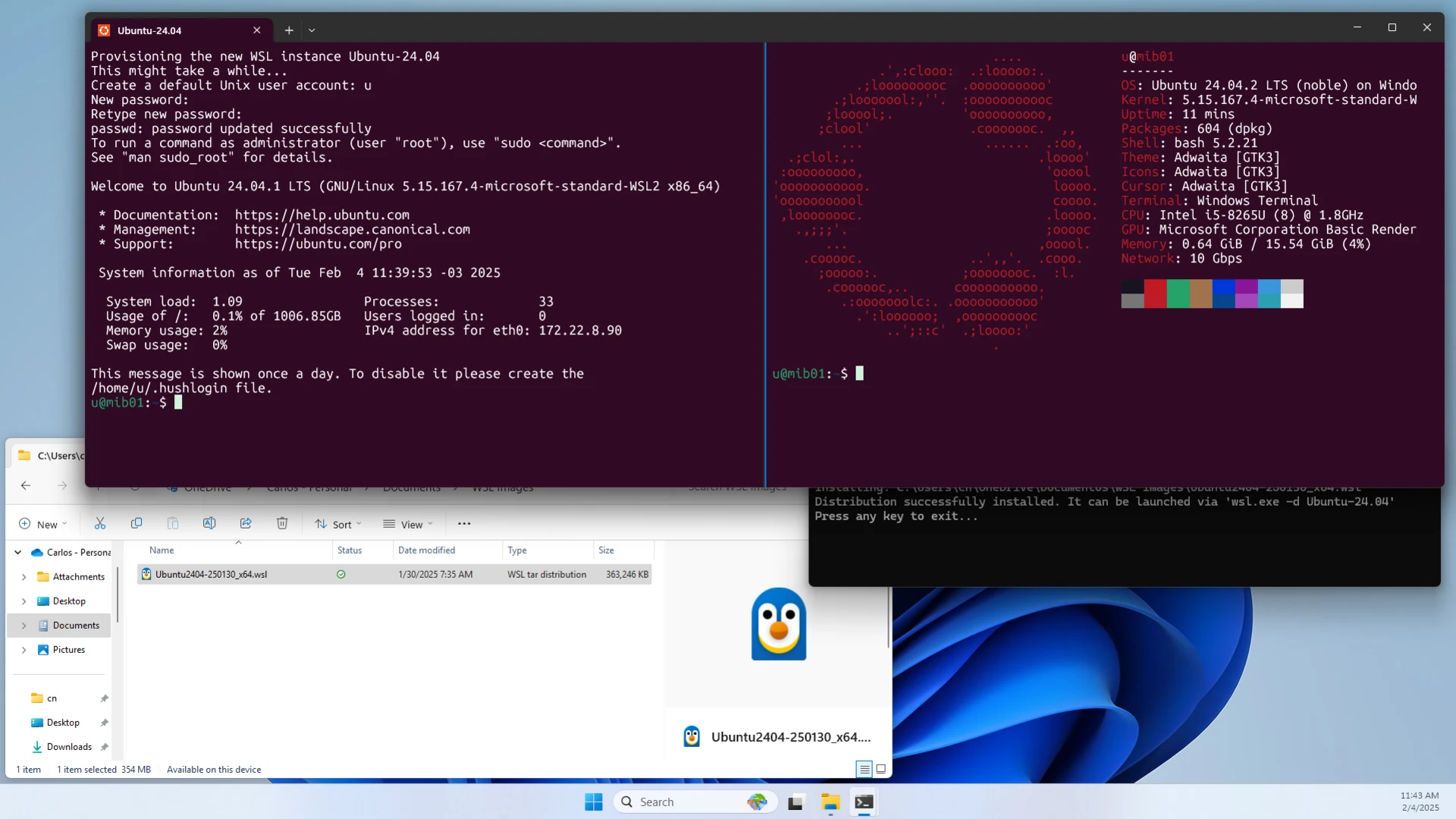
MS created WSL so developers would not have to leave Windows. It may be succeeding in that respect, but the fact that MS had to build it reveals exactly which problem the company was trying to solve.
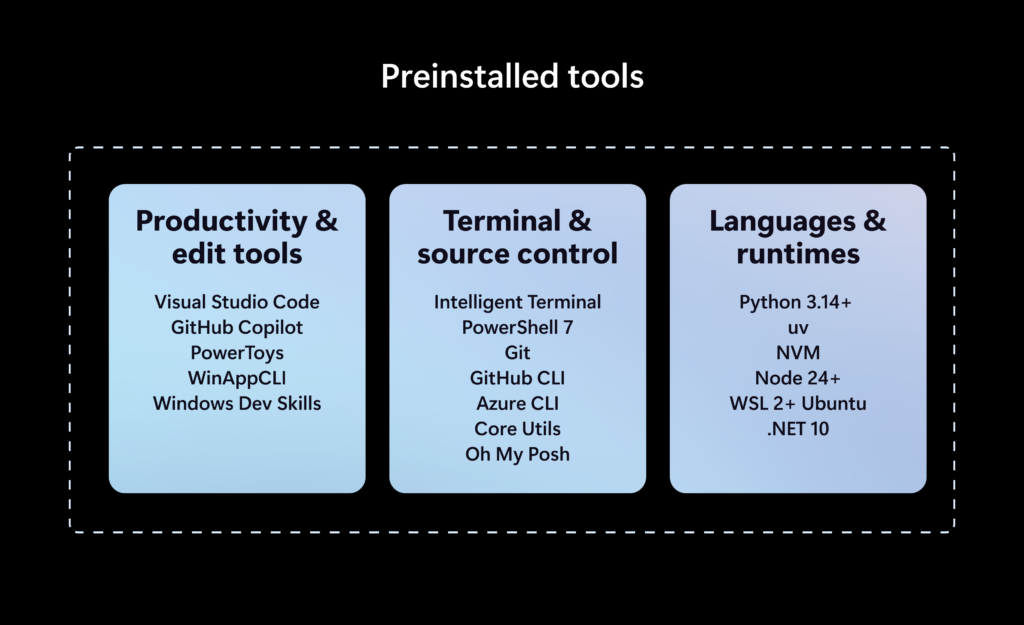
At Build 2026, MS pledged to make Windows 11 the operating system for building AI. It introduced Coreutils for Windows—a Rust-based reimplementation of GNU command-line utilities that runs natively on Windows—along with Windows Developer Configurations. Powered by WinGet, these configurations can install and set up VS Code, GitHub Copilot, WSL, and PowerShell 7 with a single command.
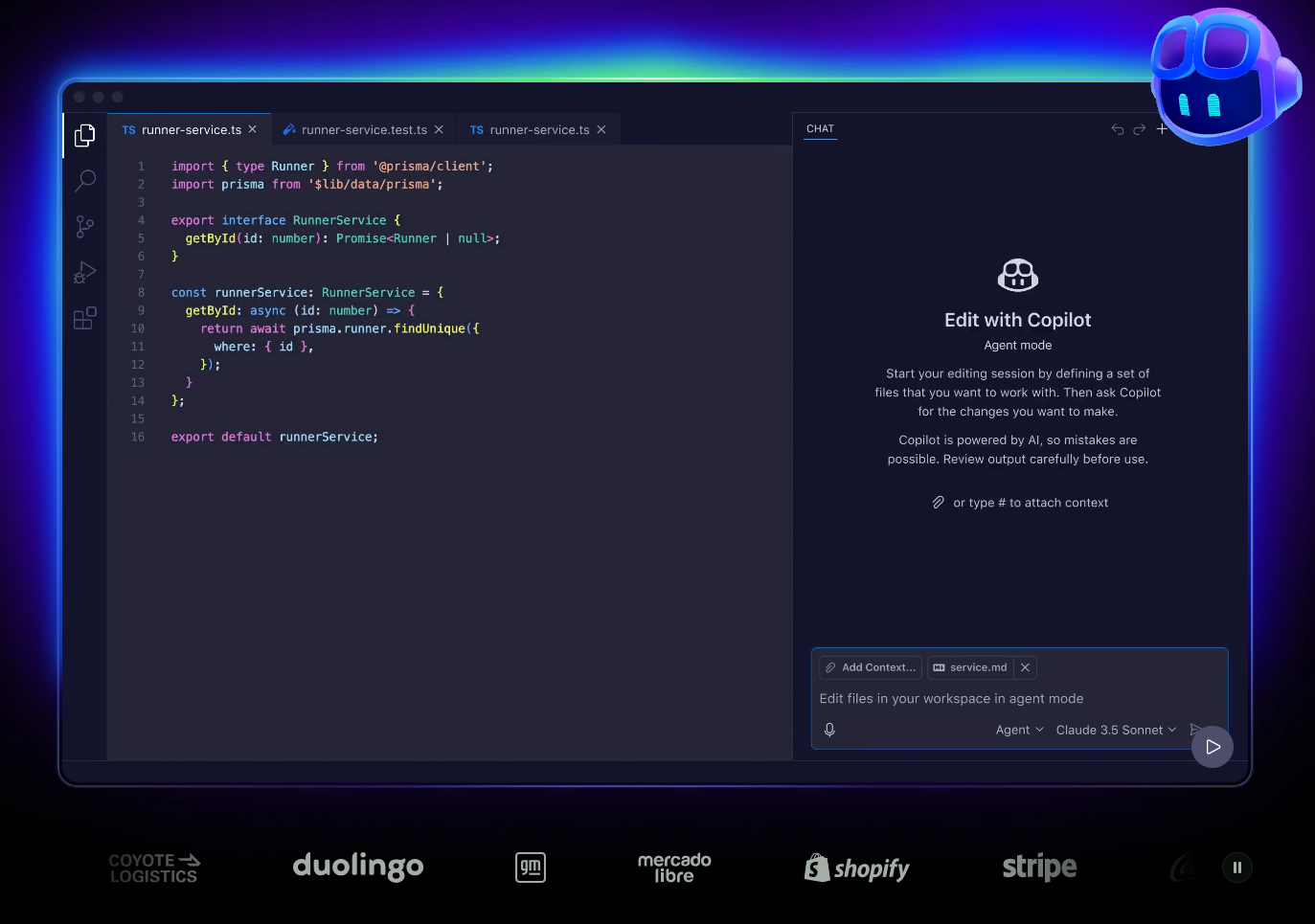
The same wave of announcements included Windows Development Skills for agentic native application development, an experimental Intelligent Terminal, and MS Execution Containers, a policy-driven layer that allows developers to control what an AI agent can access on a device.
Announced on September 4, 2026, Project Zenith is Windows with different defaults. It requires at least 64GB of unified memory and 250GB/s of bandwidth, enabling it to run 30-billion-parameter coding models locally.
MS describes it as “ready-to-code,” with Windows Terminal and VS Code pinned to the taskbar and GitHub Copilot, PowerToys, and Windows Dev Skills preinstalled.
MS is also introducing AI-focused hardware to attract developers. The Surface RTX Spark Dev Box and Surface Laptop Ultra both combine NVIDIA RTX Spark with large unified-memory configurations and CUDA support, targeting local AI development. Yusuf Mehdi has pledged to spend his final year reimagining Windows for the agentic era before leaving. MS is also expected to discuss this direction further at its October Windows event, the software giant’s first major Windows event in two years.
Contrary to popular belief, MS is not ignoring developers. It is adding Linux containers, improving WSL, releasing Linux-like command-line tools, creating developer-specific Windows configurations, and supporting these efforts with AI-focused hardware. Yet informal polls totaling 10,000 votes show Windows still trailing far behind macOS and Linux.
Windows is clearly capable of being a strong developer platform. The more difficult challenge is convincing developers that they should choose it as their development environment.
Windows Latest depends on readers like you. Make us your preferred source on Google Discover and Google Search, and help our independent reporting reach more people.